Pages

12 April 2011

Hello

I was coming into Kédougou yesterday and I passed 2 women on my bike so I greeted them:

Me - "I niŋ che" (Malinké)
Younger Woman - "Bonjour" (French)
Older Woman - "A jaramma" (Pulaar)

I laughed about this for a bit, but I think it gives a good peak into just how complicated the language situation is here.

Also...

Look what we found!

29 March 2011

Pen-Pals Anyone?

The English teacher at my Middle School is looking for English speaking pen-pals, and this is my widest reaching outlet.  I explained that our best chance was to pair up with a French class (Keep in mind that French is also a second language for these students) and maybe trade off, or do the letters half and half and it was well received.

The fact of the matter is that the students never get a chance to use English outside of the class so any bit of contact with native speakers is a big deal.  The teacher wrote up a proposal for me to send out, I'm adding it to the end of this post in grey so you can get some more information - PLEASE CONTACT ME IF YOU ARE AT ALL INTERESTED.  Just a contact is not a commitment, we'll have to discuss the logistics of everything.

I really think this is an amazing opportunity for everyone involved. Thanks for your consideration and help it is greatly appreciated.

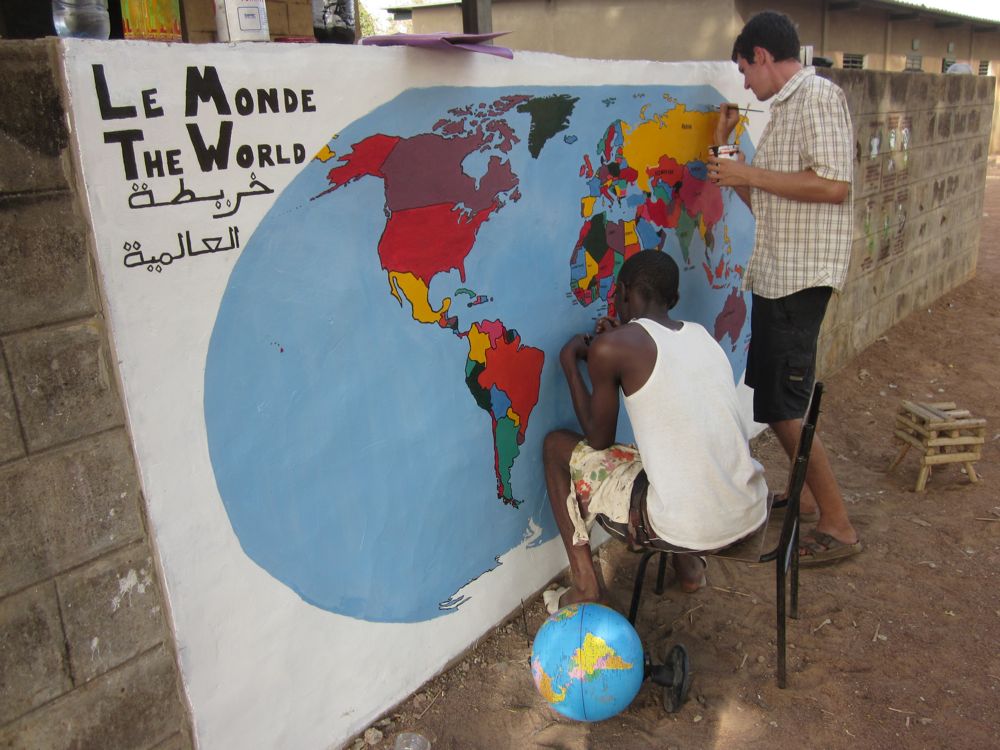
Kellen and a teacher working on the Bembou World Map
Republic of Senegal
Region of Kedougou
Department of Saraya
Khossanto Secondary School
English Club


Twinning Project of the English Club
1. Description of the context:
Senegal is a country where English is taught as a second language. The government takes much importance to the learning of that language. However the same potentialities are not offered to all students.
Learning English in Khossanto faces a lot of problems, which can be ranged from pedagogical to material ones. The fact is that Khossanto is too much isolated to the rest of the world and students are limited to their world; the only means by which the learn the language is the teacher. We do believe that Khossanto Secondary students can be given a chance. How?


2. Expectations:
This twinning project is an idea of the English Club with the help of David PUHL (Iburahima KONDJIRA) – volunteer of the “Corps de la Paix American” – who in fact, is willing to find penpals for the students.
Learning a language is learning to communicate. If you are interested in this project, if you are willing to help students foster their motivation, if you want to be a penpal with one of the students contact us.


The Headmaster  --  The Teacher Coordinator  --  The Teacher Supervisor
Samba DIALLO        Niamady SAMOURA              Aliou DIOUF
The Student Chairman of the English Club  --  Peace Corps Volunteer
Mamadou DIABY                                                  David PUHL

20 March 2011

What's the hardest part of being here?

The easy, gut response answer has little to do with development, which is what this blog is supposed to be about (sorry for not posting as often as I thought I could by the way, it turned out to be a lot more difficult than I thought); but I’ll go into that a little anyway for the honest answer.

The Fam.
I miss things in the States - food, family, friends, and the overall ease of just existing. In America the customer is always right, it is easy to take for granted just how much you expect that treatment. That concept has quite made it to Senegal yet and can be frustrating – there are no lines, you need to barge through the crowd and get up to that counter. Once there you might have to put up a fight to get the right price, or to get any kind of service at all. Be sure to greet everyone or you might wind up losing any bartering power you might have had.

It gets tiresome needing to plan your trips to the market based on what money you have on you, don’t expect change for that 10 mille bill to be at just any boutique you go to. If you want fruit or any kind of food really you should be sure to have very close to correct change… but not too close, they might not have the smaller coins either.

On a more personal end, I’ve reached the one-year mark in Senegal a week or so ago and miss seeing the faces I was so used to seeing before coming here. Pictures, Facebook, and Skype can only do so much – It’s been a year since I’ve hugged my parents, just sat with my best friend and went over all our problems. It’s shocking how much those late night talks can be missed.
Some Friends from home

My parents love to work in the garden; I want to see what they’ve done. Did my dad finish off the basement yet? My cousin’s children are growing up fast and there are two new ones that I have yet to meet. It goes the other way to, there are a few faces I’m never going to see again. Moving away from that train of thought, friends have been getting engaged and married… or even just finding a new boy/girlfriend… but these are all sacrifices I knew I was making when I signed up for this and the bottom line is that I do not regret it.

Moving into now what I think was more the point of the question – As I said, I was prepared to make sacrifices when I signed up for the Peace Corps. I was expecting to be in a small village with no electricity or running water. I’m not going to lie; I was hoping to live in a thatched roof hut. I didn’t expect to have the cell phone service that came to my village in October either.

Squat toilets have been a fun new experience – and can be their own adventure when it comes to the public variety. Sorry it it’s too much information, but toilet paper is a thing of the past unless it’s a western toilet. Once you get the system down a bucket bath (a misnomer, it’s really more of a ‘cup shower’) it pretty enjoyable. Heck, leave your bucket out in the sun for a while and you’ve even got hot water, be careful though because it can get too hot.

My hut has definitely become my home base here in Senegal. I’ve made an agreement with the ants who live in the walls, but am having a turf war with those living in my latrine. I’ve gotten used to the farm animals that hang around the family compound – I have my favorite goats and the ones I chase away on sight.

All that said, for me right now, the most difficult thing about living here is transportation. More often than not I choose to bike the 85km between my village and the regional capitol of Kédougou. Cars make the trip most days, leaving my village in the morning and coming back in the afternoons. The thing is there is no set time and depending on the car you might be stopping at every village along the way. The ride from Kédougou has taken under two hours and more than three and a half. The car has left anywhere between 3 and 7 PM, sometimes not leaving at all after sitting any waiting for it for four hours. Now that the rains have been gone for a while the dust is back so everyone is getting off the cars a shade more red than when they got on. I won’t go into details on the effect of that dust on the inside of your nose.

Cars will usually not go unless they are full – meaning each person is packed in as tightly as possible. Think about being crowded by your current standards, then add a couple more people. Also, I’ve ridden next to a man holding three live chickens. Sorry PETA, but I’ve never seen anyone hesitate to stick a sheep into a rice sack (all but its head so it can breathe) then strap it to the top of the car. In those cases you need to be careful next to the open windows in case the animal has to use the bathroom.
For the longer rides, where you have to move across country – to the capitol, Dakar, for example – it is much the same story. For those trips we fill up 7-Places, station wagons from the 60s or 70s that not surprisingly hold 7 passengers. We’re lucky in Senegal, I’ve heard they are called 8 or 9-Places in other countries. Pretty soon they are all going to just fall apart beyond repair and the public transportation system will crumble. Luckily though each driver is a pretty decent mechanic so when the car stops he can usually get it started again – oftentimes just pouring some water on something. It’s not out of the realm of possibility though for your driver to call someone else to come take you the rest of the way if he can’t fix the car fast enough. It’s convenient, but there can be a lot of waiting.

The conclusion here is that public transportation is never comfortable, you always wind up waiting for something, and it is relatively expensive. Despite your overpaying though most cars are still falling apart. I avoid it when I can, but I’ll always need to take it from time to time – I’m learning to turn off the part of me that cares about all this stuff in an effort to keep my blood pressure at a reasonable place.

10 March 2011

Sanji Kiliŋ*

Today marks one year since the day that I landed in Senegal along with the rest of “The Super Stage.” An event auspicious enough that my neighbor’s goat gave birth to not one, not two, but three kids under the bench behind my hut where I’ve taken to reading in the evenings. My contribution to the celebration will be a series of random tangents on my mind right now.

This morning they started laying out the foundation of the new Mosque in Khossanto. A cow was killed in honor of this occasion – I like to pretend it was for me, but I never did get my hands on any of that meat like I was promised. In addition, lets just say that a groundbreaking just wouldn’t be the same without arguments about both the location and size of the mosque by the village elders. It was a great show to be honest.
The Elders

I’ve built trenches (Brumes & Swales) around the few green things in my back yard to make watering my them with my bucket-bath water easier… so far so good.

The Latrine ants have stepped out of like for the last time! Bleach has made its way onto the playing field and I will be reviewing my IPM noted from training.

On a recent visit to Mamakhono I got at least three different people telling me, “I kurrata!” aka “You’re done,” as in you know all there is to know about Malinké.

Tonight, after giving my host dad a kola nut that I didn’t want I risked a conversation with the man. It came to a point where he clearly did not understand what I was trying to say so I mentally rechecked my language and tried again. He still didn’t get it, at that point his friend chimed in with, “He said he wants to see the place. What, do you not understand Malinké?” Take that Mr. “You don’t understand anything.”

I was showing my pictures to a guy who’s been living in my compound – he came across on of my graduation pictures where I’m with my parents he made two comments.
  1. My dad and I have similar faces 
  2. My mom is “Trés Belle.” That’s right mom… watch Beauty and the Beast if you don’t understand. 

A little after the graduation photo comments he detailed is plans to go to France for three months, pick up his woman friend, come back to Senegal, and when she wants to marry him he’ll pull out, “Sorry, I’m a Muslim, my family won’t let me marry a Christian.” (Sorry Mom)

Today I saw an airplane in the sky; it was weird that it was weird.

A bee stung me two days ago – that hurts! I still have a reddish spot and it’s all itchy. I left the nice tree I was sitting in because of the whole swarm coming after the stung one thing.

I biked a new way back to site from Saraya – It was amazing. Dear Adventure Racing friends come visit… actually, anyone come visit, I won’t make you bike if you don’t want to.
Albuquerque

I’ve now been in charge of a radio show all by myself. Well, someone else was there, but I wrote the script all by myself and did most of the talking and worked the soundboard (that’s what it’s called right?). I like to think that I have fans.

Dear everyone, if I see another map without a title or compass… so help me…

I think I found a home for the trees in my nursery that haven’t been eaten yet. I just need to find them protection and water.

Recent text (speaking of trees) received that made me do the happy dance: “I got you 1 orange, 2 mandarins, 1 grapefruit, 1 avocado, 1 pomegranite.”

AIDS causerie led by a woman, in Malinké, for a classroom of teenaged boys in my village. AWESOME.

Well, I’ve lost my train of thought and I really want to finish my book tonight. Thanks for reading, Year One done!
Because it's cute

09 February 2011

Right to Sight... Do what now?*

Last week I made the trip to Tambacounda (Tamba) to help with an Eye Clinic. Another Gou volunteer, KC, and I had booked tickets on the 5am bus to Tamba, meaning that be the time we got there we would still have pretty much a full day outside of travel. Unfortunately, about twenty minutes into the ride the bus broke down enough that it became obvious that it could not make the full ride to Tamba. So, the bus turned around and we made our way back to Gou. It sounds like this all happened fairly quickly… After getting our money back in a shockingly painless procedure we made our way to the “Garage” just as a 7-Place filled up and left for Tamba. Giving us the first 2 seats on the next car, which wound up leaving Kédougou at the same time we were expecting to be arriving in Tamba.
Now, moving into the Eye Clinic – A group of American health workers by the name of “Right to Sight and Health” sent two doctors and two nurses to Tamba to do as many cataract surgeries as possible. I helped out for the second week, during the first week there was another doctor around who happened to be the father of one of my Stage-mates. She heard about the clinic which has happened in Kédougou the last two years from older volunteers, told her dad the eye doctor about it, and he contacted the Right to Sight people and the rest is history. A fun story I know little about.

Anyway, Right to Sight really has a system down and knows what they are doing and likes to work with Peace Corps Volunteers when possible. Where we come in handy is all the cutting open of the eyes. Kidding, it’s the translating. The health system in Senegal is similar to the education system in that it is made up of a lot of ‘affectés.’ Meaning the person working at the Hospital or health post is not necessarily from that place and often times their spouse is back home. There is no guarantee that they speak the local language at all, nor is there any training provided to them. Normally this isn’t an issue since a majority of the public isn’t willing to pay for medical treatment – that would be the group of people Right to Sight is looking to help most. So, we step in there to translate into the variety of local languages that the area has. My mediocre French wasn’t even that much of an issue since we were working with American doctors – They did train a Senegalese doctor using French during the first week, but I wasn’t around yet.

So I showed up for my first day on the job and went to my assigned post… the operating room! The two other volunteers and I in there weren’t there handing the doctor his tools ‘stat’ or anything, but we did had tools to the nurses STERILY and they would hand them to the doctors. Gauze and other bubble-packaged items may never be opened the same again. It’s fun to not touch the inside.

There were two set-ups in the room so two surgeries could be happening at the same time, one of them was even a training microscope so during the brief bits of down time when we weren’t fetching stuff or telling patients to lie still we would take turns watching the surgery. Here’s a little rundown:
  1. “Block” eye with injection so they can’t feel anything or see anything or move their eye. 
  2. Insert speculum to keep their eye open 
  3. Sew a thread through the white of the eye that you can then clip to the eyebrow to keep the eye from moving around as you work on it. 
  4. Burn stuff so their eyes don’t bleed 
  5. Make a longer cut along the top of the iris and a tiny one on the outside 
  6. Stick in the pointy thing and wiggle until you can see the cataract spin in a full circle – careful not to rip the bag! 
  7. Use the squirty loop thing to pull out the cataract, which is basically a foggy lens. 
  8. Make sure all the little foggy chunks are out. 
  9. Insert new lens implant 
  10. Make sure the eyeball is fully inflated and the implant stays where it is meant to be. 
  11. Add liquid that seals the holes you cut in 
  12. Take everything off/out and put a patch over the eye (unfortunately not of the pirate variety) 
That’s it! All done! Hopefully you can see tomorrow when we take the patch off. Most people were thanking us before they even got off the operating table, it was really cute; for many of them though it was their only chance to see again.

By the end of the two weeks 185 cataracts were removed thanks to the Right to Sight and Health people. The last two were relatively noteworthy in that on the last day the American doctors were doing surgery – they stayed another day to do all the follow ups and pack their equipment – it turned out that there were two women waiting for surgery that couldn’t get it… for reasons that amounted to mistakes on our part. With that in mind a group of Peace Corps Volunteers set themselves to the task of convincing / guilting the Senegalese surgeon into doing the two surgeries on Friday so the Right to Sight people would still cover part of it with their money. By the time I finished helping with the last surgery they had been successful! From what I hear it was kind of a sneak attack where he was basically left no choice but to agree to doing the surgeries without being a HUGE jerk.
For the literate and illiterate

Speaking of this Senegalese surgeon… so the American doctors taught him this new surgery technique for cataract removal. By the end of the two weeks he was a master, moving faster and (according to the American doctors) with better results than his trainers. One of the Americans was so impresses that she wanted to make sure to watch him do a few surgeries to see if she could learn anything from him! I found the whole thing really impressive.

All in all it was a really good week, a good reenergizing that I was in desperate need of. There was the added bonus of getting to see friends that I hadn’t seen in a really long time all week, and get to know a few more. Then, back to Gou, and time to explain myself to my village.

09 January 2011

Long Time Coming*

It’s been a long time since I’ve written anything, and I do have a real reason for that… besides the whole living in Africa excuse. That reason being my belief in the teachings of Thumper’s father, “If you don’t have anything nice to say, don’t say anything at all.” I’ll admit it’s an exaggeration that I haven’t had ANYTHING nice to say, but there was a rough patch there for a bit (good job support crew on that by the way). Time for a breakdown.

A major buzzword in Peace Corps is ‘Sustainable’ and if you know me at all you’re probably thinking in the environmental direction and words like ‘Eco’, ‘Renewable’, and ‘Green’ are popping up too. Well you’re wrong; we’re talking about having the projects I work on continuing after I leave Senegal (side note, I do really want those other words associated with my projects too). A well-timed example of trying to make a project sustainable is the Summer Camp from a couple posts ago. The camp started a few years ago as a PC volunteer’s project, over the years it has been transitioning more an more into the hands of ADDK. That is, if Peace Corps had to pull out of Senegal right now a Summer Camp would probably happen (albeit probably only slightly resembling what we would do).

For various reasons ranging from my shy personality to cultural traits that seem specific to my village there was a question as to whether or not any work I might be able to do there would be sustainable. That question quickly led to wondering about the need for a volunteer at that site. That’s kind of a big deal, to switch sites after spending more than half a year making the connections and earning the trust to get work done is… less than desirable. In the end my supervisor (APCD) stepped in and put everything on a new track, now it’s up to me to make it work.

So we’re back to a positive and productive place in my service. Just the baseline (host) daddy issues remain and I’ve gotten pretty good at dealing with that. There’s the additional bonus that all the stress and issues distracted me from the fact that I was missing the Holiday Season with my family in America.

Now I have people to talk to, permissions to get, seeds to collect and purchase, paints to buy as well, and I might need to refresh myself on some soccer drills. The project I want to get started ASAP is the one that is inherently not sustainable, but is the easiest to start and add to my street cred – an English Club. Get together with some middle schoolers every week or so and speak English, easy enough. I’ll probably even be able to sneak in some environmental propaganda as I refuse to give up on an anti-litter campaign. Hopefully this English Club will help me get Environmental Groups going at the primary and middle schools in Khossanto. These are the groups who are going to get the school gardens started up (and hopefully pick up some of that litter).

As for the paints and permissions, there are some big blank walls just begging for a good mural, plus I need to get some stuff tagged with the Peace Corps logo in village – there’s a Canadian Flag at the middle school right now (they funded the renovations). I’m planning on at least doing an AIDS prevention mural and a hand washing/ soap use one at the middle school. I like to paint, so hopefully more will happen too.

On a more immediate level I have managed a few small successes in my family. It’s Cold Season right now, I’m talking long sleeves at night and still sweating in my t-shirt at noon, but every morning one of my first thoughts is debating if it is worth it to put on socks or not because the sun is coming out. Cold season is giving people coughs (including me), which brings me to my small successes. COVER YOUR MOUTH! I’ve only had to remind my host father a couple times to not cough directly into the food bowl, and this last time he did it I think was because we had just had a fight and I was eating a lot. Nonetheless, it is a lot better. An even smaller success comes in the form of my little brother Ibu, he has done a lot less coughing directly into my face while we play. He even coughs into his elbow, but I think that’s just making fun of me. Hey, I’m not going to fight it, if it picks up a good habit by making fun of me it’s all good.

The next step is getting him not to cough into the food bowls either, he’s graduating from the women’s bowl and coming the bowl I eat at more often… but he’s small so when he coughs it just goes in his section. Don’t want to rush anything; I’ve got a good thing going here. If you give a mouse a cookie though… now that they are starting to cough into their hands I’m reminded how often they use soap to wash their hands. The answer is only if they use soap to shower with, which is not often, and the women when they do laundry but that’s unintentional anyway.

Donding Donding / Petit à Petit / Little by Little

03 January 2011

My Work

There was a request for more information for more details on what I am doing in Senegal. As it turns out this is a fairly good time to talk about that, I’m just getting out of some issues at site leading to meetings with important people and a more defined role for me in Khossanto.
I’m going to take the Peace Corps mission right off of the website to make things easier for me to begin with:
Mission 
In 1961, President John F. Kennedy established the Peace Corps to promote world peace and friendship.  The Peace Corps' mission has three simple goals: 
1. Helping the people of interested countries in meeting their need for trained men and women. 
2. Helping promote a better understanding of Americans on the part of the peoples served. 
3. Helping promote a better understanding of other peoples on the part of Americans. 
From my end this blog in and of itself is helping me reach that third goal (thanks!), and just living here takes care of the second goal. It’s that first goal that gets tricky. Peace Corps is run a little differently in each host country but in recent years the focus has been a lot more on development. It probably has a lot to do with the United Nation’s Millennium Development Goals.

I think I’m getting a little off track now, so let’s get back to it… what am I doing in Khossanto. I guess I’m still working on what do I want to do there and that has to do with those issues I mentioned earlier. Whatever it is I do I want to make sure that it is sustainable in that once I leave the project will continue to be effective. A problem arises when you can’t find anyone in your community to work with. I was having problems with that for a while but quite recently we had a meeting in my village with my Senegalese supervisor and the important people of Khossanto. The meeting went very well and led to some fairly solid project ideas that I hope to get started in the next few months. I’ll highlight a few of my favorites.

SCHOOL CLUBS. I’ve wanted to form environmental clubs at the primary and middle schools in my village since before I even made it there. This will be a chance for me to really get the environmental message to the youth, which in my opinion is the most effective way to make a change happen. I’ve been uncertain how to really get these started until this meeting where a good stepping-stone was suggested at the middle school level - English Club. Some students have chosen to learn English… as a native speaker I think it is safe to say that my help would be appreciated. Get together once a week or so and chat, this gives me a chance to introduce certain environmental concepts as well as get some more work on my French and Malinké. Here’s a quick list of some topics I hope to work on in these clubs: littering is bad, all frogs won’t kill you, some insects are good for your garden, wash your hands with soap after going to the bathroom and before eating, go to the bathroom in the latrines, compost, and I’m sure more will pop up as time goes on.

WOMEN’S GROUP. My village already has a well-developed women’s’ group with a sizeable garden and previous volunteers have helped them to practice good gardening practices. Where I can help is by helping to update some of those gardening practices tailoring it to the land they are using (it happens to spend the rainy season underwater). Another more difficult thing I want to do with the women’s group is to try to help put them in contact with people who want to buy the vegetables they grow in their garden. I also want to work with them to get a tree nursery started so we can plant trees at the schools and in family compounds that will provide shade from the hot hot sun. Ideally they will also produce some kind of delicious and nutritious fruit for the village as well.

I would also like to help get latrines made throughout the village. Right now a lot of family compounds don’t have a place to go to the bathroom, kind of like if only one house in your neighborhood had a toilet. What winds up happening is that people will just do their business wherever, flies will land on it, when the flies are done there they will then land on your food. I think you can see the issue there.

The real key to everything I try to do here is working closely with people in my village.  As I mentioned before I want the projects I do to continue once I go and the only way to ensure that happens is to work with Senegalese counterparts every step of the way.  When I have pride and take ownership in my work I certainly try to keep in from falling apart, I'm hoping I can work with people like that here.  So there's a bit of an overview of my work here in Senegal.  I hope you have a better idea of what I'm doing here and, as always, keep asking questions!